

Higher Ed as Social Infrastructure: CUNY’s Role in Economic Mobility
How public urban universities serve as regional mobility engines, bridging low-income access and top-quintile income-ladder outcomes.

When we talk about social infrastructure in New York City, we often look at parks, plazas, and transit hubs. But public higher education anchors, specifically the CUNY system, can act as some of the most powerful institutional mobility engines in the country.
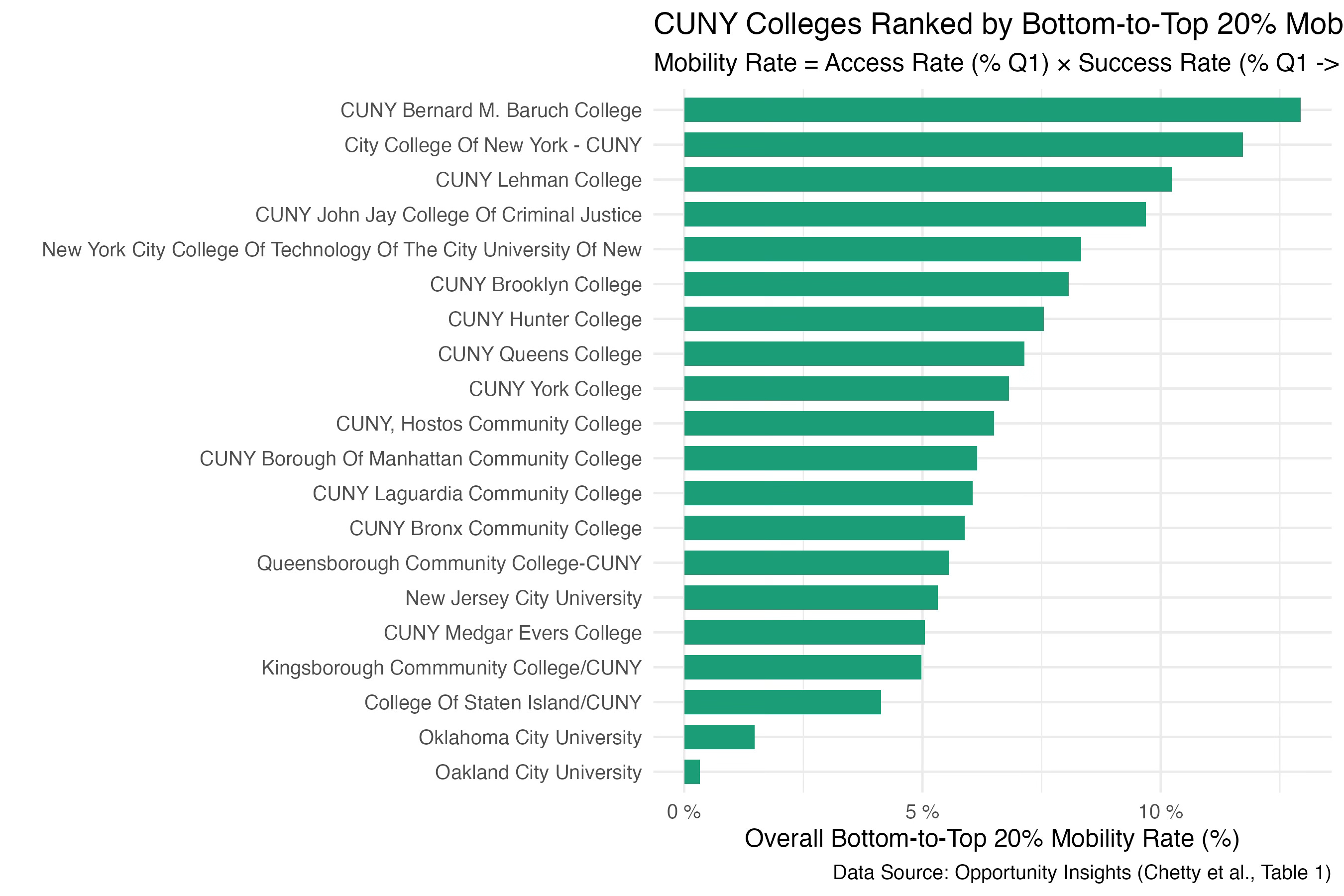
Using Opportunity Insights data (Chetty et al.), this chart ranks colleges by their overall Bottom-to-Top 20% Mobility Rate, the product of a school’s access rate (% of students from the bottom 20% income quintile) and its success rate (% of those students who reach the top 20% as adults).
The Key Takeaway:
Urban public colleges dominate the top ranks. Baruch College (~12.9%) and City College of New York (CCNY, ~11.7%) lead the pack, followed closely by Lehman College (~10.2%), John Jay (~8.5%), City Tech (~8.3%), and Brooklyn College (~8.1%). CUNY schools may act as crucial spatial and economic bridges, moving students directly from low-income ZIP codes into middle- and upper-class networks across the city.