

The Mobility Engine Matrix: Access vs. Success in American Higher Education
Elite universities offer high success rates but lock out low-income students. CUNY does the impossible. Enrolling high shares of low-income students while catapulting them into the top quintile.

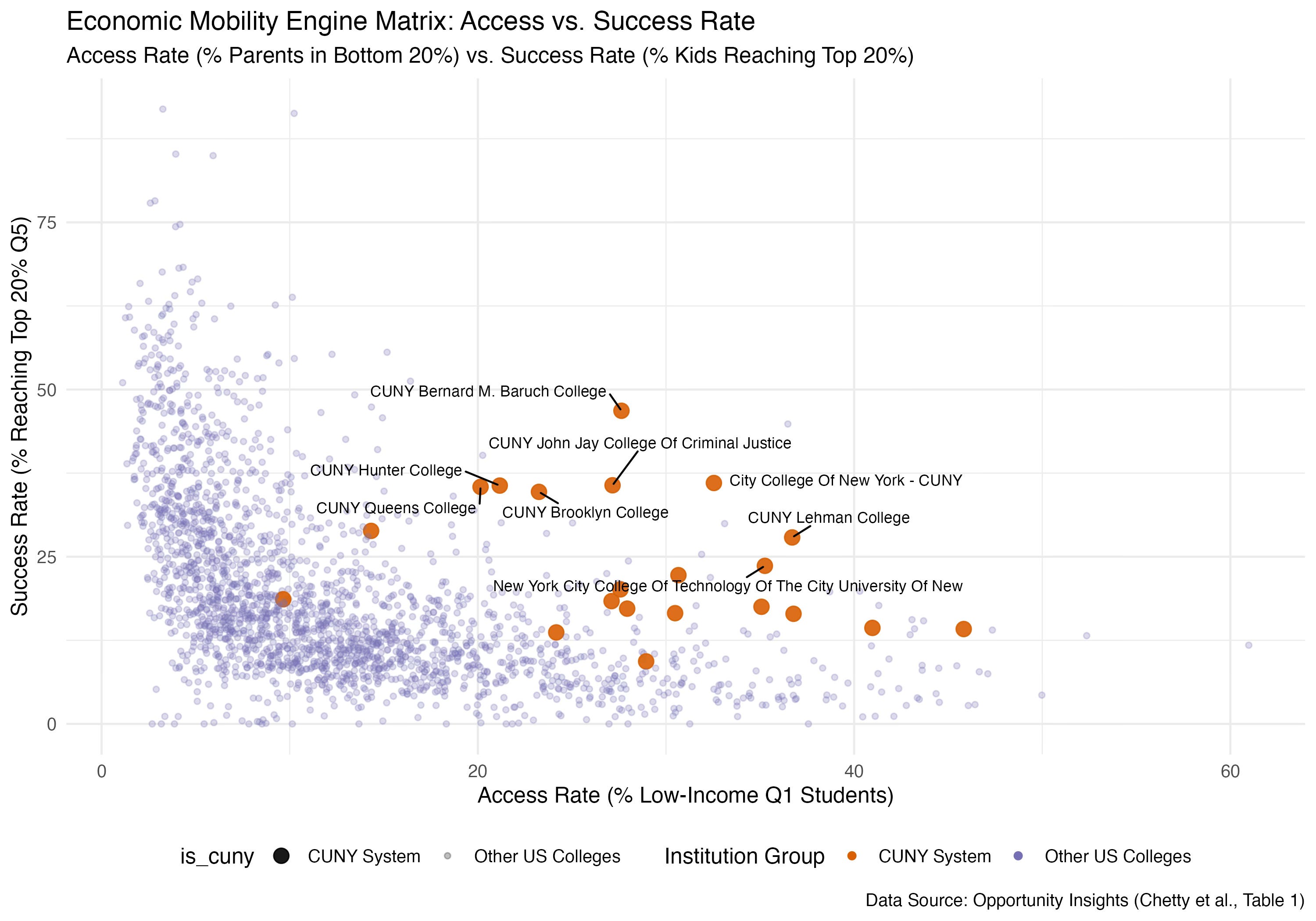
Look at where CUNY sits compared to the rest of higher education in the United States.
Most elite colleges in America live in the top-left quadrant of this matrix. They boast high Success Rates (a large percentage of their graduates reach the top 20% income quintile), but their Access Rates are abysmal—often enrolling fewer than 5% or 10% low-income students.
On the flip side, many institutions with high access rates struggle to provide the career pipelines needed to propel low-income students into the upper income tiers.
As shown in orange, CUNY campuses sit firmly in the upper-right quadrant. Institutions like City College (CCNY), Lehman, City Tech, John Jay, and Baruch enroll massive proportions of students from the bottom 20% income quintile (often 20% to 35%+ of their total student body), while simultaneously achieving success rates that rival selective private universities.
When you multiply high access by high success, you get true institutional mobility—proving that public higher education remains NYC’s most potent engine for social and economic mobility.